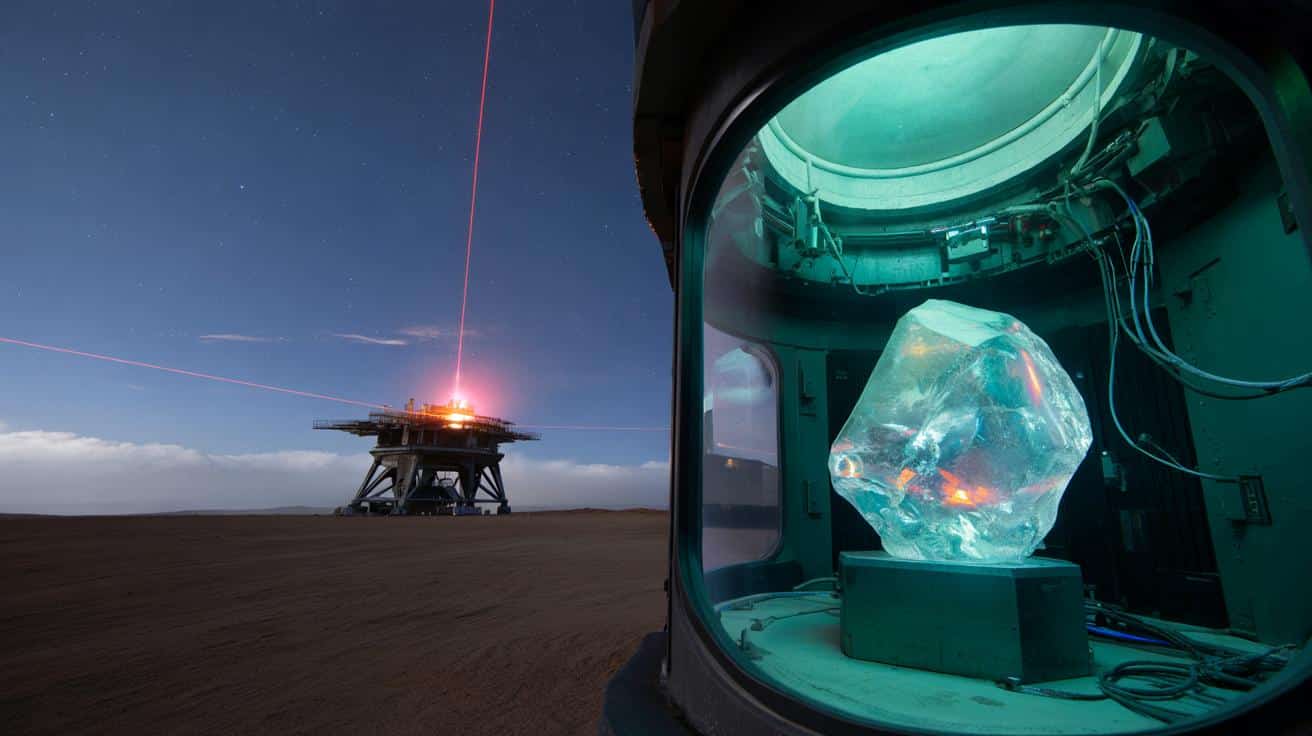
What looks like an obscure materials science experiment could soon spill over into the space race. Chinese researchers say they have grown a record-breaking crystal designed for high-power lasers, a technology that could, in theory, target satellites hundreds of kilometres above Earth from a mountaintop or desert base.
A laser crystal built to punch through the atmosphere
The new material is known as BGSe, short for barium gallium selenide. It is what physicists call a “nonlinear optical crystal”, a component that changes the colour and properties of a laser beam passing through it.
In this case, BGSe converts short-wavelength infrared light into mid and long-wave infrared beams. Those wavelengths matter. They pass through the atmosphere with far less loss, even in clouds, dust or light rain.
BGSe lets ground-based lasers keep their punch over hundreds of kilometres, making space-based targets technically reachable from the surface.
According to a report from the Chinese Academy of Sciences in Hefei, the team has produced a BGSe crystal 60 mm across. In laser optics, that is enormous. The larger the crystal, the more energy it can handle and the wider the beam it can shape.
Engineers have long been hemmed in by fragile optics. Push the power too high and crystals crack, cloud or simply explode. That bottleneck has limited the range and usefulness of directed-energy weapons. BGSe aims to change that.
Ten times tougher than many military-grade materials
The standout figure is the crystal’s damage threshold: up to 550 megawatts per square centimetre. For context, many materials currently used in military laser systems fail around 50 MW/cm².
The Chinese crystal reportedly endures roughly ten times the energy that standard military laser optics can tolerate without burning out.
This resilience comes at the cost of a brutal manufacturing process. The crystal ingredients are heated to around 1,020°C in a vacuum to prevent any trace of oxygen or water vapour. Once melted, the material is slowly cooled and allowed to grow over weeks.
➡️ Belgium’s “betrayal” of France will leave a mark on the future of Europe’s defence
➡️ France on track to become the world’s 4th biggest power in ultra-secret SIGINT spy aircraft
➡️ Poland overtakes France, Germany, Italy and the UK with a historic tank force beyond imagination
An industrial recipe with no room for error
After fusion, the crystal is annealed at about 500°C, then its temperature is gradually stepped down by roughly 5°C per hour. This painfully slow ramp is designed to avoid internal stress, microscopic cracks and chemical defects.
Once solid, the raw block is far from ready. It is cut with diamond saws, then polished with fine abrasives such as cerium oxide paste. Technicians spend dozens of hours removing sub-microscopic scratches and inclusions that could deflect or absorb light.
- Any tiny bubble can trigger a hotspot.
- Any dust particle can scatter the beam.
- Any crack can act as a fuse and destroy the crystal under load.
Chinese researchers have been working on BGSe since at least 2010. Western labs, including those in the US and Europe, have experimented with similar compounds but have not yet matched this combination of size and robustness at scale.
Civilian cover, military implications
Officially, Chinese publications emphasise peaceful uses: ultra-sensitive infrared detectors, medical imaging systems, advanced scientific sensors for astronomy and Earth observation.
Those uses are credible. Mid- and long-wave infrared light are ideal for picking up temperature differences, spotting gas leaks or scanning the human body without harmful radiation. A single large BGSe crystal could feed several high-end cameras or spectrometers.
Yet the military logic is hard to ignore. A crystal that survives extreme laser power, works at atmospheric “transparency windows” and can be made in relatively large pieces fits neatly into ground-to-space directed-energy weapons.
On paper, a BGSe-based system could dazzle satellite cameras, fry sensitive detectors or damage antennas without firing a single missile.
The history of laser weapons underscores why the optics matter. In the late 1990s, a US Navy test of a high-energy laser reportedly failed when internal crystals degraded under heat. Power was not the only challenge; keeping the beamline alive was just as tough.
From dazzle to destruction: what such a system might do
Military planners think in categories of effect, not just raw power. A laser using BGSe optics might be tuned to do several things:
| Effect | Potential impact on a satellite |
| Dazzling | Temporarily blinds optical sensors, degrading imaging or targeting for minutes or hours. |
| Permanent sensor damage | Burns or pits camera arrays or infrared detectors, forcing the satellite offline or reducing its performance. |
| Component heating | Heats antennas, solar arrays or exposed electronics, leading to failures or shortened lifespan. |
| Structural damage (extreme case) | At very high power and precise tracking, could compromise small appendages or thin components. |
Subtle, reversible effects such as dazzling may be especially attractive to states that want to send signals without creating debris fields or triggering treaty debates about “attacks” in space.
A quiet arms race aimed at low Earth orbit
China’s move comes against a backdrop of intense but often secretive competition in laser weaponry. The US, Russia, Israel and several European countries invest heavily in high-energy laser research, both for air defence and potential counter-space roles.
Low Earth orbit has become crowded with satellites for navigation, communications, reconnaissance and weather monitoring. Many of these systems support military operations on the ground, from guiding jets to directing artillery.
A country able to consistently interfere with such satellites without kinetic interceptors gains a new form of leverage. Directed-energy systems, while complex and power-hungry, are silent, fast and relatively hard to attribute definitively from afar.
For comparison, one of the world’s most powerful research lasers, the ZEUS system at the University of Michigan, relies on a titanium-doped sapphire crystal roughly 17 cm across. That crystal took years to perfect. China’s 6 cm BGSe piece, grown in under a year according to state-linked reports, points to a rapid scaling effort focused specifically on infrared applications and high durability.
Why infrared and crystals matter in plain language
Space and weapon technologies often sound arcane, but two ideas explain much of the fuss: wavelengths and damage thresholds.
Wavelength describes the “colour” of light, even outside what our eyes see. Certain wavelengths travel through air and clouds with fewer losses. Mid- and long-wave infrared sit in those sweet spots, especially useful when you are firing from the ground through a turbulent atmosphere.
Damage threshold is simply how much power a material can take before it breaks. If your optics cannot survive the beam, you never get a useful weapon. By pushing that threshold up by a factor of ten, Chinese researchers are widening the envelope of what can be attempted from the surface.
Scenarios that worry military planners
Analysts looking at this development tend to sketch similar scenarios:
- A ground station turns a laser on a spy satellite passing overhead, temporarily blinding its cameras during a key operation.
- Multiple beams systematically degrade the sensors of a constellation used for missile warning, thinning out early-warning coverage without destroying any satellites outright.
- In peacetime, intermittent “testing” against foreign satellites sends a political message, while remaining difficult to attribute with certainty.
Each scenario blurs the line between electronic warfare and physical attack. It also raises questions for international law, which has struggled to keep up with non-kinetic space weapons that leave no debris and may only cause partial, reversible harm.
Risks, countermeasures and what comes next
Satellites are not defenceless. Designers can add shutters, filters or sacrificial optics in front of sensitive sensors. They can harden electronics against heating and introduce manoeuvres to shift orientation if they detect unusual light levels.
Those defences add cost and complexity, though, and they are always chasing the last technological step made on the ground. The more robust ground-based lasers become, the more mass and money satellite operators have to invest in protection.
There are also basic physical constraints facing laser weapons. Beam quality degrades over long distances because of turbulence and scattering in the atmosphere. Adaptive optics — systems that continuously adjust mirrors to correct for that distortion — are themselves challenging and fragile. Power supply is another headache; sustaining hundreds of megawatts per square centimetre on target demands either large stationary facilities or major advances in compact power systems.
Still, the BGSe breakthrough narrows one of the biggest gaps: the vulnerability of internal optics. By taming that problem, China has taken a concrete step toward higher-power, longer-range directed-energy systems. Whether they remain laboratory curiosities or move into operational units will depend on how quickly other parts of the kill chain — tracking, power and beam control — catch up.