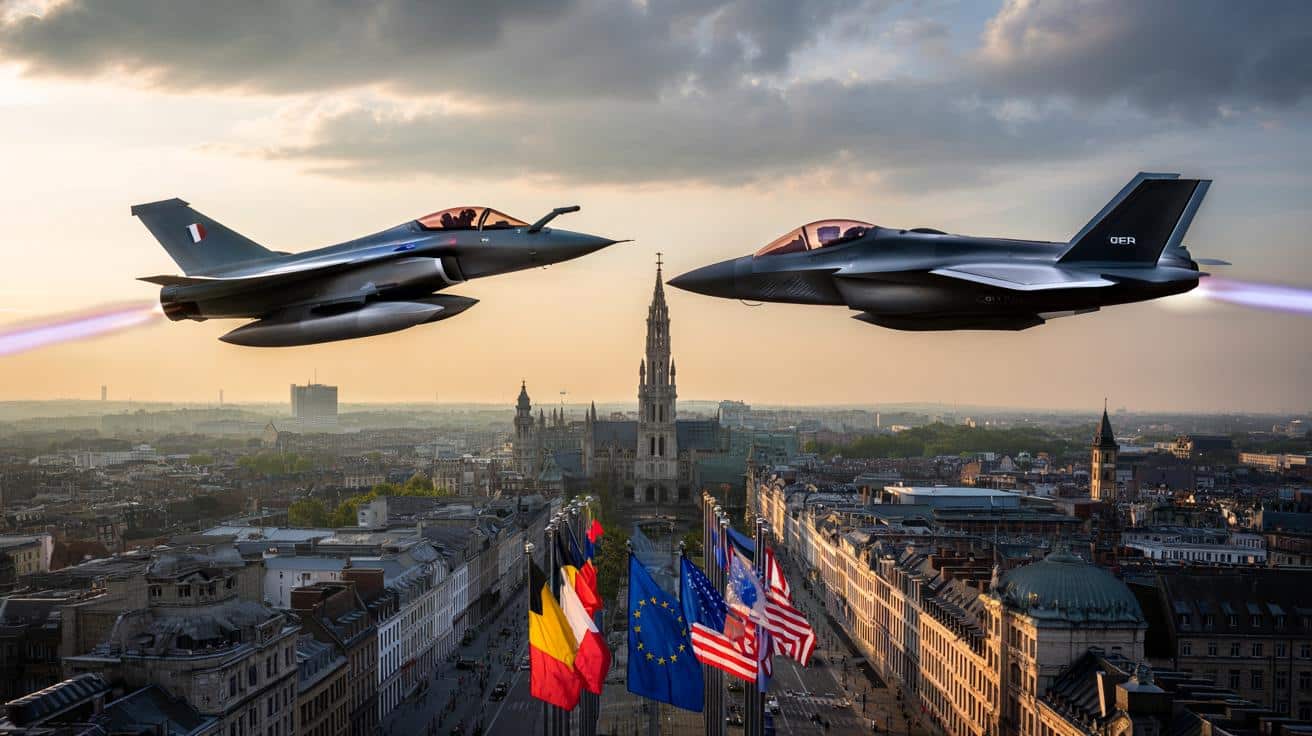
Belgium’s decision to buy American F‑35 fighters instead of France’s Rafale has gone far beyond a simple procurement choice, stirring accusations of “betrayal”, exposing fault lines inside NATO, and raising fresh doubts about whether Europe can ever build genuine military autonomy.
How a fighter jet tender turned into a political earthquake
Belgium’s ageing F‑16 fleet dates back to the 1980s. Replacing it was always going to be expensive, technical and highly politicised. In 2018, Brussels launched a tender for a new generation fighter, aiming to lock in its air power for the next three decades.
Two main contenders emerged: the US‑made F‑35A from Lockheed Martin and the French Rafale from Dassault Aviation. Both are combat‑proven, both used by NATO allies, both backed by aggressive diplomatic campaigns.
In October 2018, the Belgian government announced its choice: 34 F‑35As for more than €1 billion. Officials pointed to the F‑35’s stealth, deep integration with NATO systems and its growing user club across Europe.
What looked like a straightforward NATO‑friendly decision has instead become a symbol of Europe’s struggle to pick between US protection and its own strategic independence.
Seven years on, the debate has not faded. Delays in deliveries, higher‑than‑planned maintenance costs and political backlash in Paris have turned the purchase into a long‑running diplomatic sore.
French frustration: an ally snubbed on its own continent
For France, the blow is not only commercial. The Rafale sits at the heart of Paris’s strategic narrative: high‑end, homegrown technology, designed and controlled in Europe, and increasingly successful on global markets.
The jet equips the French Air and Space Force and Navy, and has been sold to Greece, Croatia, Egypt, India and the United Arab Emirates. It flies combat missions from the Sahel to the Middle East. French officials insist it is fully interoperable with NATO systems, despite not being American.
What stings in Paris is the message behind Brussels’ recent wording. The Belgian defence ministry publicly described Rafale as “not relevant” to national needs. That phrase has been widely quoted in France as a diplomatic slap in the face.
➡️ China is building the world’s largest laser crystal to shoot down satellites from the ground
➡️ Poland overtakes France, Germany, Italy and the UK with a historic tank force beyond imagination
Éric Trappier, chief executive of Dassault Aviation, has accused Belgium of speaking “with two voices”: publicly backing European defence and industrial sovereignty, while privately signing its biggest cheques to US suppliers.
Industrial stakes: offsets, jobs and long‑term influence
The French offer reportedly came with significant industrial offsets: jobs in Belgian factories, technology transfers and long‑term partnerships for local companies. This kind of package is standard in Rafale exports and a core argument for buyers seeking political support at home.
The F‑35 model is very different. Final assembly remains in the US (and in a secondary Italian line). Partner nations compete for work on sub‑components, but the most sensitive technologies stay firmly under American control. That limits both local industrial value and strategic freedom.
By turning its back on Rafale’s deeper industrial integration, Belgium has effectively chosen US defence guarantees over European defence autonomy.
F‑35 vs Rafale: different jets, different dependencies
The technical debate around the two aircraft is complex and often heated. The F‑35 is billed as a fifth‑generation, network‑centric, stealth aircraft; the Rafale is officially a “4.5‑generation” jet but has been continuously upgraded with new sensors, weapons and electronic warfare suites.
| Aspect | Rafale | F‑35A |
| Origin | France (European supply chain) | United States |
| Generation label | 4.5 | 5 |
| Engines | Twin‑engine | Single‑engine |
| Software access | Controlled by France, modifiable for export | Source code locked by the US |
| Industrial returns | Structured offsets, local workshare | Limited sub‑system opportunities |
| European users | France, Greece, Croatia and others | Belgium, Italy, Netherlands, UK and others |
Supporters of the F‑35 in Belgium highlight its stealth profile and tight integration with US‑led operations. Critics reply that its availability rates have been patchy, its life‑cycle costs very high, and that the aircraft locks users into a dense web of US‑controlled software and data systems.
The Rafale, while less stealthy on paper, offers greater openness: export customers can negotiate custom equipment, software adaptations and partial local maintenance. For countries worried about digital sovereignty, that flexibility carries weight.
The software lock‑in nobody sees on the runway
The most sensitive issue is invisible: the code that runs the jets. No F‑35 customer, including close allies, has access to the aircraft’s core mission software. Updates, major repairs and some diagnostic tools remain controlled by Lockheed Martin and US authorities.
This means that, in a crisis, any F‑35 user relies on American goodwill to keep its fleet fully operational and updated. Restrictions on certain weapons or functions could, at least in theory, be imposed remotely or via withheld updates.
In military aviation, sovereignty now lives less in metal and more in millions of lines of code.
Rafale buyers, by contrast, deal directly with French industry and state authorities, with scope to adapt software and integrate non‑US weapons. That does not eliminate dependence, but it keeps it inside a European political framework.
A glaring contradiction with Europe’s own ambitions
The Belgian case exposes a broader puzzle. Brussels is involved in European defence initiatives such as the Future Combat Air System (FCAS in English, SCAF in French), led by France, Germany and Spain. That programme aims to develop a new generation air combat system by around 2040, including a fighter to succeed Rafale and Eurofighter, plus unmanned “wingmen” drones and a secure combat cloud.
So why would a country signed up to a European future platform invest tens of billions, over time, in a closed US system that will dominate its air force for decades?
For many analysts, this looks less like long‑term planning and more like short‑term risk management. The F‑35 ties Belgium even more tightly into NATO and US command structures at a moment of renewed insecurity, from the Baltic to the Black Sea.
French lawmakers, including strongly pro‑European voices, have accused Brussels of “strategic disloyalty”. Their concern is less emotional than structural: if EU members keep buying American combat systems, the business case for shared European programmes weakens, and their technological gap with Washington widens.
Two‑speed Europe: shared speeches, diverging purchases
The Rafale‑F‑35 saga highlights a pattern. Many EU states speak openly about “strategic autonomy”, but when large contracts arrive, political leaders often pick US platforms. The reasons are familiar: trust in US security guarantees, pressure inside NATO, established user communities, and domestic reluctance to risk untested European cooperation.
- Smaller states fear being left alone against threats and lean towards the US umbrella.
- US equipment often comes with training, intelligence sharing and visible political backing.
- European projects can be slow, bureaucratic and plagued by national rivalries.
This creates a two‑speed landscape. A handful of countries, led by France, push hard for European defence industries and joint projects. Others prefer to “hedge”, supporting European ambitions in speeches while buying into US‑led ecosystems when it affects their core forces.
Every major US contract signed by an EU member chips away at the political momentum behind a stand‑alone European defence pillar.
What this means for NATO, Russia and future crises
The timing of the Belgian decision and the ongoing debate matters. Europe faces a more aggressive Russia, hybrid attacks against its infrastructure, and shifts inside NATO as Washington asks Europeans to spend more on defence.
From a purely NATO point of view, Belgium’s F‑35 purchase is convenient. The aircraft is deeply embedded in US planning, can share data instantly with other F‑35 fleets, and fits the alliance’s integrated air defence architecture.
From a European autonomy angle, the picture is much less comfortable. If many European skies are guarded by US‑designed, US‑coded jets, European governments may struggle to act fully independently in a crisis where US and EU interests diverge.
Scenarios often mentioned by defence planners include operations in North Africa or the Middle East, where Washington might prefer to stay out while Europe feels compelled to act. In those situations, reliance on American software, weapons approvals and logistics chains could limit European freedom of manoeuvre.
Key concepts behind the controversy
What “strategic autonomy” really means
The phrase “European strategic autonomy” gets used a lot but rarely unpacked. In concrete terms, it refers to the ability of European states to decide and conduct military operations without being blocked by outside powers, whether politically, technologically or logistically.
That does not mean leaving NATO or cutting ties with Washington. It means having credible options if the US is unwilling, distracted, or chooses a different course. Fighter jets, secure communications, satellites and missiles are all pieces of that autonomy puzzle.
How procurement decisions shape power for decades
When a country buys a fighter jet, it commits for 30 to 40 years. Training systems, spare parts, weapons, mission data, simulators and software updates all come with the aircraft. Over time, this creates what economists call “lock‑in effects”. Changing paths later becomes extremely expensive.
In Belgium’s case, the F‑35 will anchor its air force firmly in a US‑centric ecosystem well into the 2050s. Any shift towards a future European system, such as FCAS, would require new investments, dual fleets or a painful transition.
Defence is one of the few markets where a single contract can shape a country’s strategic posture across two generations.
For countries still debating their next fighter purchases, the Belgian story serves as a live case study. The short‑term benefits of aligning tightly with the US come with long‑term questions about sovereignty, industrial capacity and Europe’s ability to act as a genuine power in its own right.