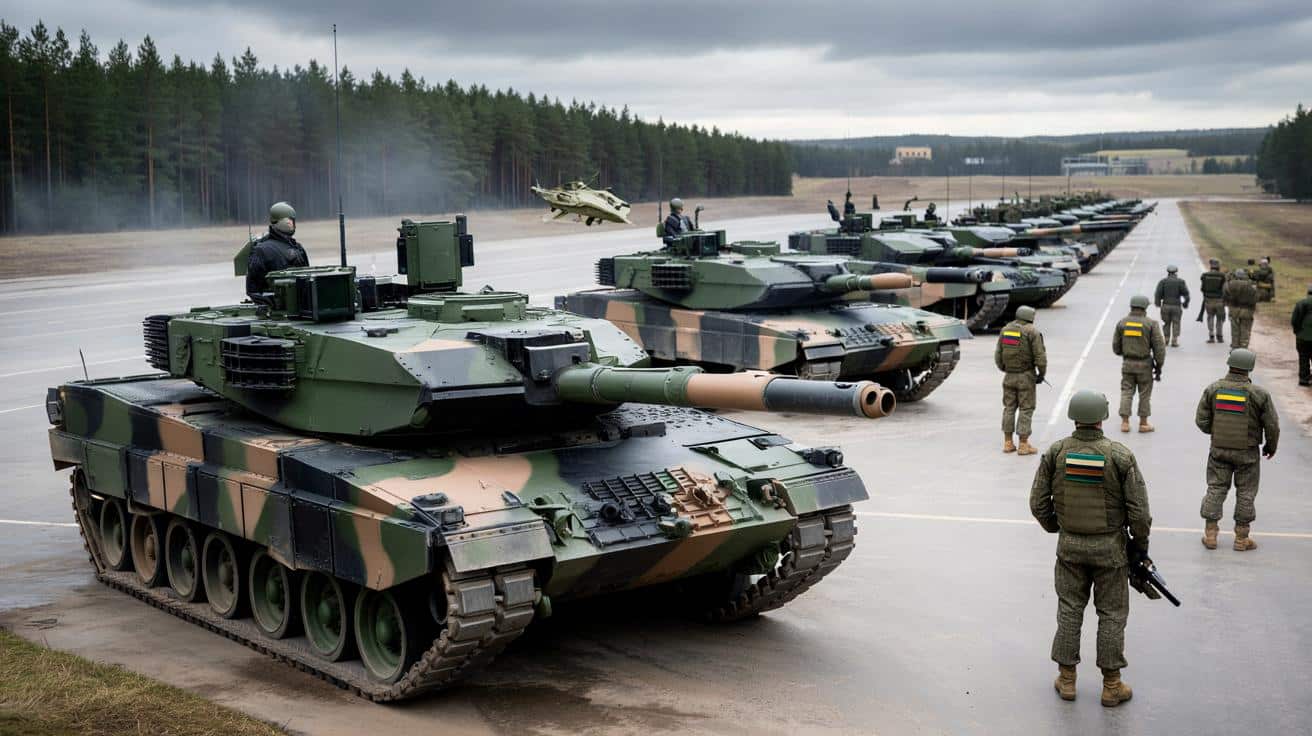
Lithuania has agreed a major loan to buy brand-new German Leopard 2A8 tanks, creating the first heavy armoured battalion in its history. For Vilnius, this is less about prestige and more about signalling to Moscow that the Baltic state will not be an easy target.
A historic tank battalion for Lithuania
Since regaining independence from the Soviet Union in 1990, Lithuania has never fielded a true heavy tank force. Its army has relied on lighter armoured vehicles, infantry and NATO support. That picture is about to change.
The Lithuanian government has signed off on a €461 million loan to join a multinational order for 44 Leopard 2A8 main battle tanks from the German defence group KNDS. The deal was wrapped up quietly in December 2024, but its meaning is loud enough for anyone watching the Baltic region.
For the first time, Lithuania will operate a full battalion of modern Western main battle tanks, positioning itself as a hardened frontline state rather than a soft edge of NATO.
Deliveries are planned before 2030. That sounds distant, yet in defence planning terms it is almost tomorrow. The decision locks in Lithuania’s path for the next decades: deeper integration with NATO heavy forces and a clear bet on German armour.
Leopard 2A8: what these tanks actually bring
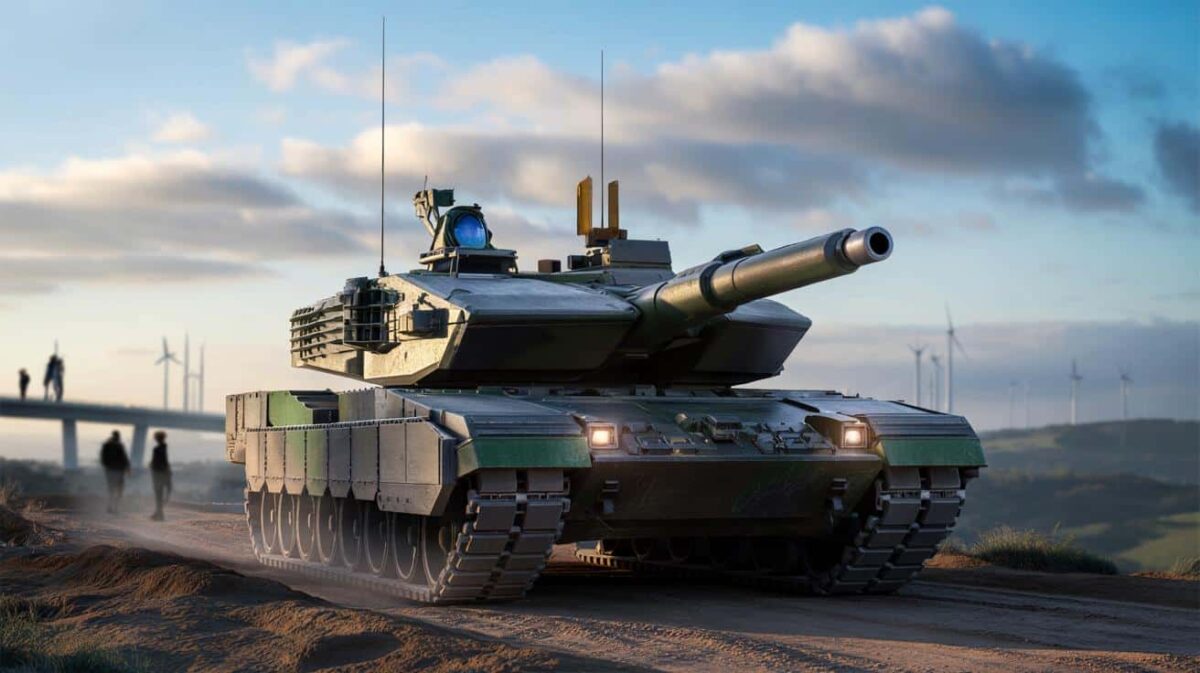
The Leopard 2A8 is the latest iteration of a design widely seen as one of Europe’s most capable tanks. Lithuania is not buying museum pieces for parades; it is purchasing combat systems tailored for high-intensity war.
Built to take hits and hit back fast
The new Leopards combine thick passive armour with advanced protection systems. Their reinforced hulls are designed to reduce the damage from mines and roadside bombs, a threat that has dominated recent wars from Iraq to Ukraine.
On top of that, the 2A8 comes equipped with EuroTrophy, an active protection system that detects incoming anti-tank rockets or missiles and attempts to destroy them before impact. That layer of defence is especially relevant on Eastern European terrain, where infantry armed with cheap anti-tank weapons or loitering munitions can appear from forests, villages or concealed positions.
Firepower is equally central. The Leopard’s 120 mm smoothbore gun can pierce roughly 600 mm of armour at more than 2,000 metres, depending on the ammunition. Modern optics, thermal cameras and a 360-degree sensor suite give the crew a wide and detailed view, day and night.
➡️ France on track to become the world’s 4th biggest power in ultra-secret SIGINT spy aircraft
➡️ Belgium’s “betrayal” of France will leave a mark on the future of Europe’s defence
➡️ China is building the world’s largest laser crystal to shoot down satellites from the ground
➡️ Poland overtakes France, Germany, Italy and the UK with a historic tank force beyond imagination
From detection to firing, a Leopard 2A8 can respond to a threat in under three seconds, a critical edge when drones, missiles and tanks all share the same battlefield.
For Lithuania, these details matter. Any clash near its borders would unfold fast, with little time to move reserves. A force that can sense further, react quicker and survive longer complicates any Russian planning in the region.
The “Leopard club” and NATO interoperability
Buying Leopard 2A8 is also a political and logistical choice. It ties Lithuania into a European network of countries already operating Leopard variants, from Germany and Poland to the Netherlands and Norway.
That means common spare parts, standardised ammunition, shared training centres and multinational exercises where crews can swap tactics using the same basic platform. For NATO planners, this simplifies reinforcement scenarios along the eastern flank.
For Lithuania, it also means leverage. Instead of relying on second-hand donations, as it once did, Vilnius is entering long-term industrial and military partnerships. That changes how it is perceived in European defence circles: less recipient, more stakeholder.
A regional rearmament wave in Eastern Europe
Lithuania’s tank deal is one node in a wider pattern since Russia’s full-scale invasion of Ukraine in 2022. Governments from the Baltic Sea to the Black Sea are rewriting their defence playbooks, often with tanks and heavy armour at the core.
| Country | Main tank / armour orders | Approx. quantity | Estimated budget | Planned delivery |
|---|---|---|---|---|
| Lithuania | Leopard 2A8 | 44 | €461 million | Before 2030 |
| Poland | Leopard 2A7, K2 Black Panther, M1 Abrams | 1,000+ | Over €10 billion | 2025–2032 |
| Romania | Leopard 2A7 | 54 (confirmed) | About €1 billion | From 2026 |
| Czech Republic | Leopard 2A7+ (via Germany) | 14 plus options | Partly German-funded | 2026–2027 |
| Slovakia | Leopard 2A4 (donation), CV90 infantry vehicles | 15 tanks, 152 CV90 | €1.7 billion for CV90 | 2026–2028 |
Estonia has invested in K9 Thunder self-propelled howitzers from South Korea. Latvia is upgrading its existing armoured fleet. Finland, which has joined NATO, is speeding up deliveries of heavy equipment and improving infrastructure for reinforcements.
Eastern Europe, once seen as the alliance’s soft rear, is turning into its forward shield. NATO units exercise there more often, depots of fuel and ammunition are growing, and new training grounds are being prepared for larger formations.
Why Russia’s tank numbers still worry the Balts
Quantity from the East, proximity at the border
On paper, Russian tanks have not always impressed in Ukraine. Many models still rely on outdated optics, limited protection and improvisation on the battlefield. Yet numbers matter, and Moscow has been pushing its factories hard.
Western estimates suggest that Russian plants at sites such as Chelyabinsk and Nizhny Tagil can refurbish or produce around 100 tanks a month, mostly older designs like the T-72 and T-80 with varying levels of modernisation. The quality can be uneven, but the volumes are significant.
From Kaliningrad or Belarus, Russian armour would be only hours away from Lithuanian cities, a geographic reality that shapes every Baltic defence decision.
Lithuania shares no direct border with mainland Russia, but it lies next to Kaliningrad, a heavily militarised Russian exclave, and Belarus, whose regime is closely aligned with Moscow. War games in NATO capitals routinely test scenarios in which these territories play a central role.
This is why Vilnius is shifting from a focus on missions abroad to building layered defences at home: stocked ammunition, new simulators for crews, expanded reservist training and now, a tank battalion able to anchor defensive lines or spearhead counter-attacks.
The unspoken subject: a message to Moscow
Officials talk in code, strategy does not
Baltic officials rarely name Russia directly. Press conferences are filled with phrases such as “regional threats”, “aggression scenarios” or “hybrid risks”. Everyone in the room understands what that means without the word “Russia” ever appearing.
The Leopard deal fits that pattern. Lithuanian leaders present it as a contribution to NATO and as a guarantee that they can hold their ground until allies arrive. Within that language lies a simple calculation: if Moscow knows the first push will be costly, it might not push at all.
Other states in the region think similarly. Poland is building one of Europe’s largest land forces. Romania and the Czech Republic are modernising air and ground fleets. The overarching goal is to raise the threshold at which the Kremlin considers any move beyond Ukraine.
What a tank battalion actually looks like
For those outside the defence bubble, a “battalion” can sound abstract. In practical terms, Lithuania’s future tank battalion will likely field:
- Around 40 to 50 Leopard 2A8 tanks, grouped into companies
- Hundreds of soldiers, including crews, mechanics and support staff
- Recovery vehicles, engineering assets and command posts
- Integrated drones and reconnaissance elements to spot targets
Training such a unit takes years. Crews must learn not just to handle their own tank, but to coordinate with infantry, artillery, engineers and aircraft. Night manoeuvres, live-fire exercises and joint drills with other NATO armies will become routine for Lithuanian forces as the Leopards arrive.
For civilians, the most visible change will be more heavy tracked vehicles on rail lines and roads, new hangars near bases, and extended military zones used more frequently throughout the year.
Key concepts behind Lithuania’s move
Dissuasion by denial rather than punishment
Defence experts often distinguish between two types of deterrence. Deterrence by punishment promises massive retaliation after an attack. Deterrence by denial aims to make the initial attack itself unlikely to succeed.
Lithuania’s bet on heavy armour sits clearly in the second camp. The goal is to convince Russian planners that any attempt to seize territory quickly would meet strong resistance from day one, from fortified positions backed by well-armed, well-trained units.
Risks, trade-offs and future scenarios
This path comes with trade-offs. Tanks are expensive to buy, fuel and maintain. Money spent on Leopards is money not spent on other priorities such as air defence, cyber security or social programmes. Large, visible armoured formations can also become targets for long-range missiles or drones, as shown in Ukraine.
Yet, for Lithuania, the alternative would be to rely almost entirely on allied reinforcements. In a crisis, bad weather, damaged infrastructure or political hesitation could delay those forces. A national armoured battalion, sitting on home soil, is a hedge against that risk.
In future crises, the Leopards may never fire a shot. Their main role might be symbolic: a line of steel and doctrine that says, clearly, that the road from Russia to the Baltic capitals runs through well-defended ground. For a small state next to a large, unpredictable neighbour, that message is the point.