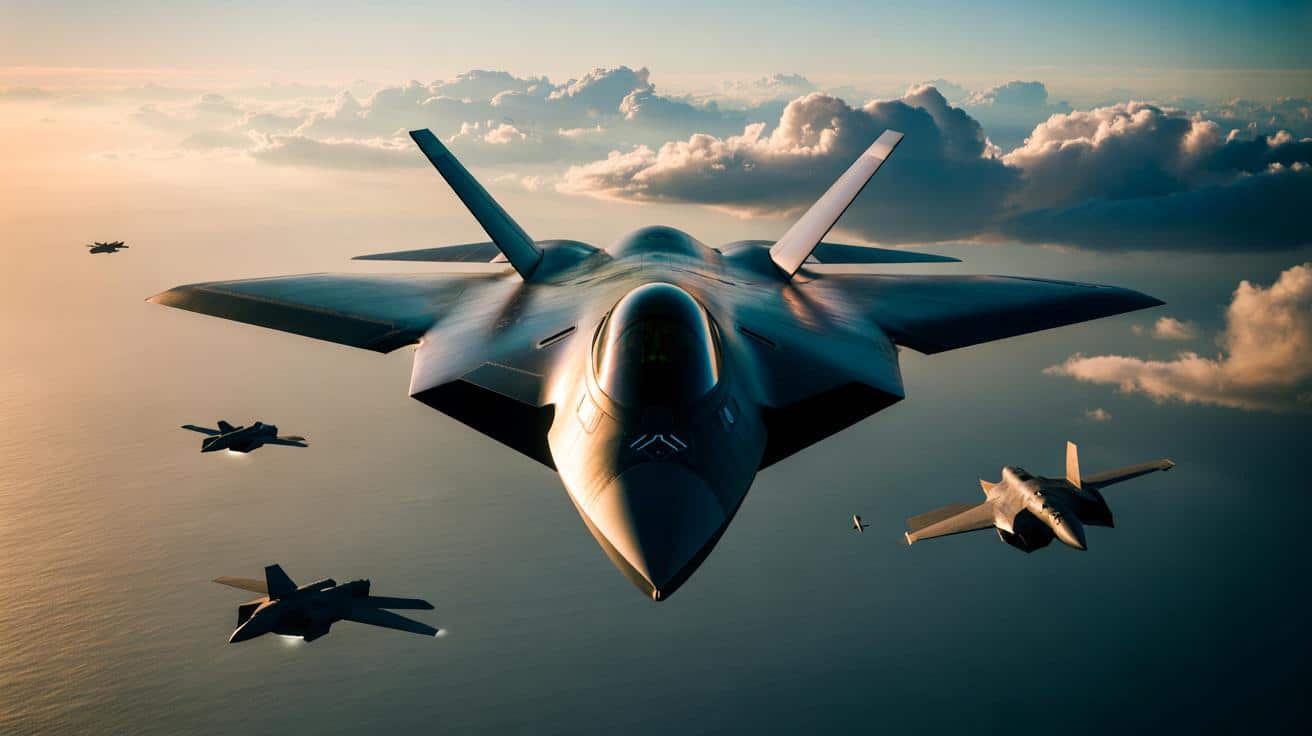
That aircraft, the Northrop YF-23, was stealthier and potentially more future-proof than the F-22 Raptor that eventually won. Three decades later, as the F-22 is being retired with no true successor in service, the decision is raising uncomfortable questions inside the Pentagon.
A competition that shaped American air dominance
The context was the end of the Cold War. Washington wanted a new “Advanced Tactical Fighter” to beat Soviet MiG-29s and Su-27s and guarantee air superiority well into the 21st century. Two prototypes faced off: Lockheed’s YF-22, which would become the F-22 Raptor, and Northrop’s YF-23.
Both designs were fifth-generation fighters: stealthy, supersonic without afterburner, packed with sensors and advanced avionics. Yet they embodied two different visions of air combat.
- YF-22: extreme agility, with thrust-vectoring nozzles for tight turns and airshow-style manoeuvres
- YF-23: deep stealth, long range and high-speed cruise, with less emphasis on dogfighting theatrics
On paper, the YF-23 had clear advantages in range and radar signature. On the test range and in the political arena, those advantages never fully translated into victory.
The United States chose the more spectacular demonstrator, not necessarily the aircraft better suited to a future of long-range, missile-driven warfare.
An aircraft that looked like a UFO for a reason
The YF-23 did not look like any previous American fighter. Its diamond-shaped wing, drooping nose and canted tail surfaces gave it an eerie, almost alien profile. That silhouette was not about style; it was about survival against radars and heat-seeking missiles.
Northrop built two prototypes. One, painted in black, was nicknamed “Black Widow II”, a nod to the company’s Second World War night fighter. The other, in light grey, was known as “Grey Ghost”. Both could cruise at roughly Mach 1.6 without using fuel-guzzling afterburners – around 1,975 km/h – a major tactical asset for getting in and out of hostile airspace before enemy aircraft could react.
Further, faster, quieter
Beyond raw speed, the YF-23’s key selling point was reach. Its combat radius was estimated to be significantly greater than the YF-22’s. That extended range would have allowed US forces to strike deep targets or patrol distant frontiers with fewer tanker aircraft and fewer vulnerabilities.
The design also paid particular attention to infrared stealth. Instead of round, exposed nozzles, the YF-23 used wide, flattened exhausts buried in the rear fuselage. That shape helped cool and shield the hot engine plume, reducing the chance of detection by heat-seeking sensors and missiles.
➡️ Belgium’s “betrayal” of France will leave a mark on the future of Europe’s defence
➡️ China is building the world’s largest laser crystal to shoot down satellites from the ground
➡️ Poland overtakes France, Germany, Italy and the UK with a historic tank force beyond imagination
➡️ France on track to become the world’s 4th biggest power in ultra-secret SIGINT spy aircraft
With its range and stealth profile, the YF-23 looked like a natural bridge between traditional fighters and the long-range, networked air warfare emerging today.
The US Navy briefly considered a navalised version to replace ageing F-14 Tomcats. The idea did not survive budget cuts and inter-service rivalries, but it showed how far some planners were willing to think with the YF-23 as a base.
Northrop lost the show, not the specs
Where Lockheed won decisively was not just in engineering, but in theatre. During official trials, YF-22 pilots performed dramatic high-angle-of-attack manoeuvres, tight loops and live missile firings. The aircraft showed off its agility and stability at 9G, playing straight into traditional fighter culture.
Northrop’s team, more conservative and wary of risk, kept the YF-23 away from the edge of its envelope in public demonstrations. Many of its potential strengths remained numbers in reports rather than scenes on video. Within the Air Force, some later described this as a communications disaster.
Performance assessments at the time suggested the two prototypes were broadly comparable. Yet decision-makers walked away with a much stronger emotional impression of the YF-22 as a “fighter pilot’s aircraft”. In a service steeped in dogfighting mythology, that mattered.
Trust and politics weighed heavily
Technical scores were only one line on a much longer spreadsheet. In the late 1980s and early 1990s, Northrop was still dealing with the fallout of audits, programme overruns and congressional criticism on previous projects. Lockheed, though hardly perfect, enjoyed a more favourable perception in Washington.
There was also the question of industrial balance. Awarding the F-22 to Lockheed helped distribute major contracts among the big defence primes at a time when the Pentagon was consolidating its suppliers after the Cold War. Some analysts argue that this industrial logic quietly tipped the scales.
The YF-23 did not just lose to the F-22; it lost to an ecosystem of habits, risk aversion and political calculations.
F-22: a technological marvel that arrived at the wrong time
The F-22 Raptor itself is no failure in performance terms. It remains one of the most capable air-superiority fighters ever flown, with unmatched agility and a very low radar signature. Yet the programme stumbled on economics and timing.
The Air Force initially wanted around 750 aircraft. Budget pressure, changing threat perceptions after the collapse of the Soviet Union, and spiralling costs slashed that number. Production stopped at just 186 operational F-22s, with a unit cost north of $200 million once development was spread across the small fleet.
The US shut down the production line and scrapped many of the specialised tools. Restarting it today would be prohibitively complex. The aircraft that was supposed to dominate air combat for decades is already on a retirement glide path, limited in export by legal restrictions and facing growing maintenance challenges.
By betting on a very sophisticated but extremely expensive fighter, Washington locked itself into a narrow fleet, with too few aircraft to cover global commitments. The YF-23’s potentially lower operating costs and better range might have offered more flexibility in the long run, even if it had required more development work at the beginning.
Why many strategists now prefer the YF-23 on paper
Modern air warfare is moving away from close-in dogfights and towards long-range engagements, sensor fusion and stand-off weapons. In that environment, the YF-23’s design philosophy looks surprisingly modern.
Better fit for long-range conflict
With its emphasis on range, stealth and high-speed cruise, the YF-23 would have been particularly relevant in a conflict over vast distances, such as a Pacific theatre confrontation. Operating from dispersed bases, able to cover wide areas without constant refuelling, it matched many of the operational challenges emerging today with China and Russia.
Analysts argue that a fleet built around such an aircraft could have relied less on vulnerable tanker aircraft and forward airfields. That kind of resilience is becoming a central concern in US war games.
What might have been: a 40-year air dominance plan
If the YF-23 had been selected and matured, the US could have fielded a fighter optimised for stealth and reach that still left room for agility upgrades later. Incremental improvements in sensors, weapons and engines might have kept it relevant for four decades, much like the F-15 has been repeatedly modernised since the 1970s.
| Aspect | F-22 path | Hypothetical YF-23 path |
|---|---|---|
| Primary focus | Agility and dogfighting | Stealth and long-range missions |
| Production volume | Low (under 200) | Potentially higher if cheaper to operate |
| Strategic fit today | Still formidable, but limited in numbers | Better aligned with long-range, missile-centric combat |
| Upgrade potential | Hampered by small fleet and closed line | Could have evolved into a long-lived family of variants |
No one can prove that the YF-23 would have been cheaper or easier to maintain. Yet many in the defence community argue that the F-22 choice, combined with later bets on the F-35, left the US with a complex, costly mix instead of a larger, more sustainable high-end fleet.
Key terms and ideas behind the debate
Several concepts sit at the heart of this controversy and are worth clarifying.
- Stealth (low observability): Design choices that reduce how easily radars, infrared sensors or acoustic systems can detect an aircraft. Shapes, materials and engine exhaust treatment all feed into this.
- Supercruise: The ability to fly supersonic without afterburner. This saves fuel and reduces the infrared signature, making it harder for adversaries to detect and intercept the aircraft.
- Combat radius: The maximum distance a fighter can fly to conduct a mission and return, taking into account time on station and fuel reserves.
In current US planning, these factors intersect with a larger concern: contested logistics. Aircraft that can operate far from tankers and vulnerable bases reduce the number of weak points an adversary can target. The YF-23’s advocates argue that its design lined up more naturally with that logic than the F-22’s.
What the YF-23 story says about future choices
As the US invests billions into its next-generation air-dominance programme (NGAD), the YF-23’s fate is turning into a cautionary tale. There is growing pressure to avoid repeating a cycle where a technically brilliant aircraft ends up too expensive and scarce to shape a conflict at scale.
The episode also highlights the risk of letting showmanship and short-term industrial considerations overshadow long-term strategy. A fighter that looks impressive in a high-g manoeuvre might not be the one that quietly wins a missile exchange 1,000 kilometres from the nearest friendly base.
For planners and engineers working on future concepts, the YF-23 is more than a museum piece. It is a reminder that the most advanced aircraft is not always the one that gets built – and that those choices can echo for decades across defence budgets, alliance planning and the balance of power in the skies.