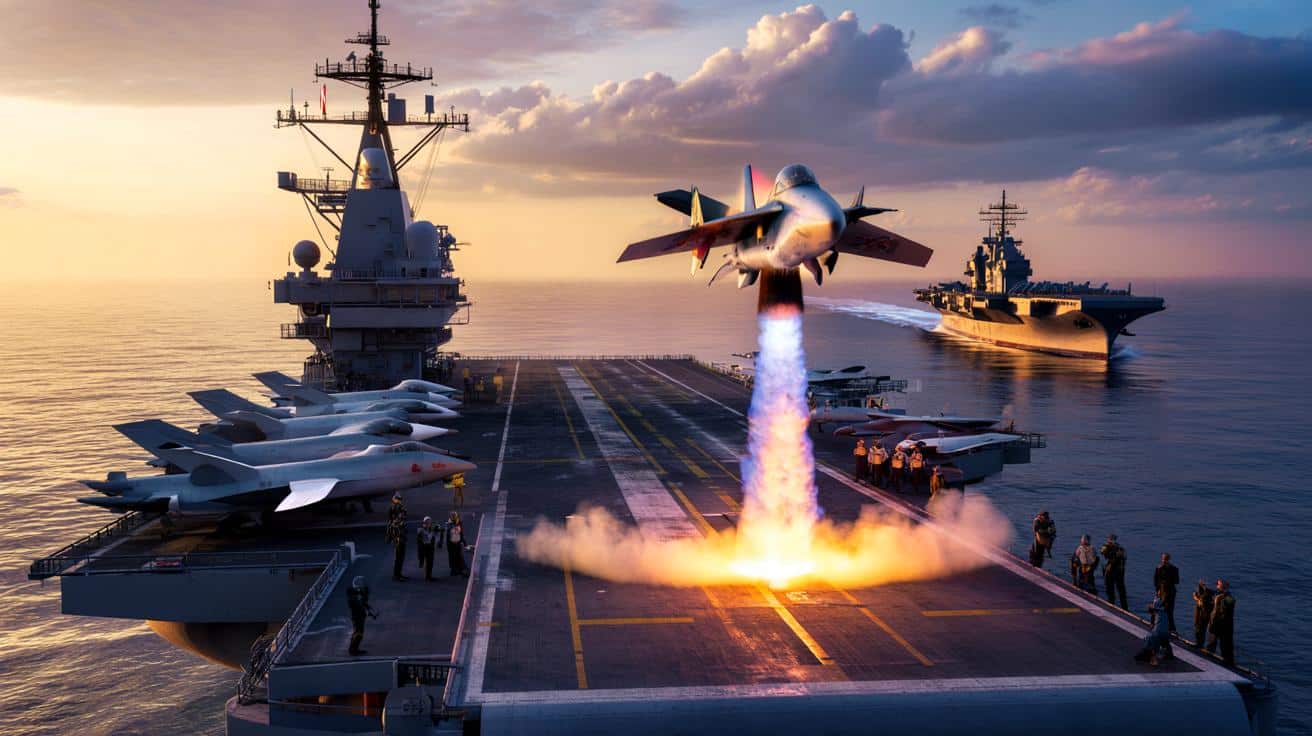
That sound came from the Fujian, China’s newest and most advanced aircraft carrier, and it marked a move that quietly drags the country’s navy into the same technological club as the United States – right down to a once-exclusive high-tech launch system.
Fujian’s electric leap puts China in a new league
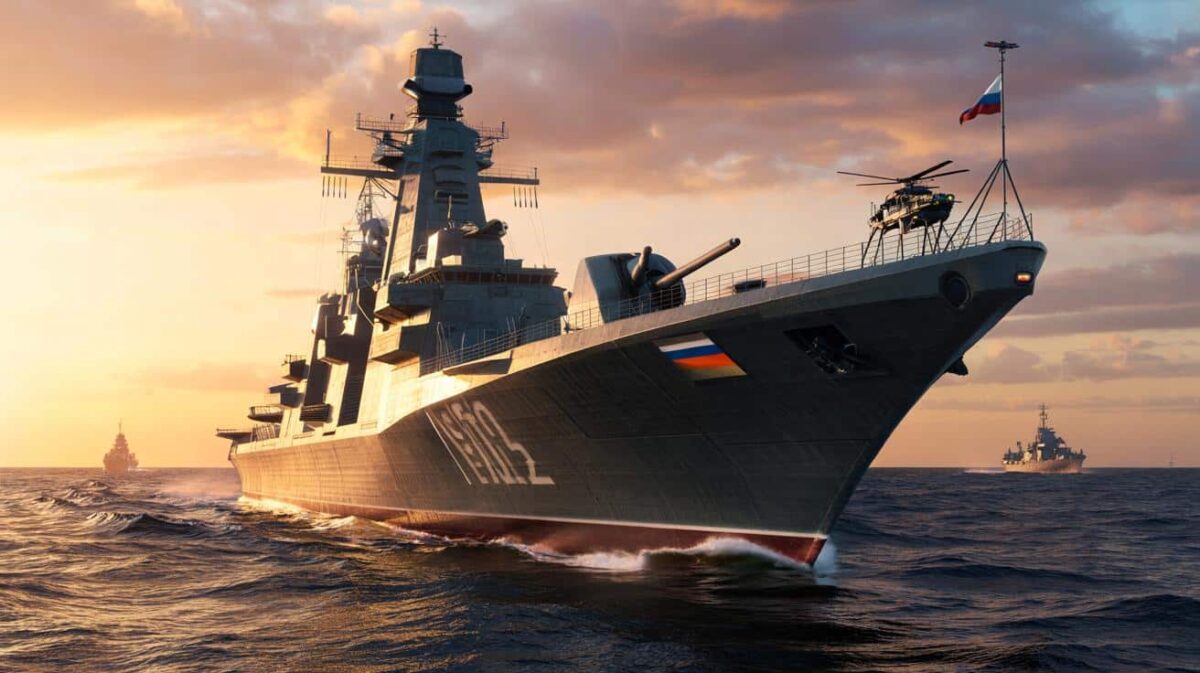
The Fujian is China’s third aircraft carrier, but it is the first that can credibly stand beside America’s latest supercarriers on a technical level.
On 31 July 2025, Chinese state media and open-source analysts converged on the same conclusion: Fujian had carried out its first catapult aircraft launch at sea. No heroic video, no Hollywood-style flyby, just radio chatter, excited voices on deck, and a shadow on the flight deck captured by distant cameras.
The launch appears to confirm that China has mastered electromagnetic catapult technology once monopolised by the US Navy.
For Beijing, the timing matters. The test came just days before the 98th anniversary of the People’s Liberation Army (PLA), turning a technical milestone into a political message: China now fields a carrier that is not merely symbolic but genuinely cutting-edge.
The high-tech novelty: EMALS, the electromagnetic launch game-changer
At the centre of the story is EMALS – the Electromagnetic Aircraft Launch System. This is the same category of system used on the US Navy’s newest carrier, the USS Gerald R. Ford.
Instead of using steam pressure to hurl jets off the deck, EMALS relies on controlled electromagnetic pulses to accelerate aircraft down a straight rail.
- More precise acceleration control
- Lower stress on the airframe
- Ability to launch heavier aircraft
- Shorter reset times between launches
- Reduced maintenance compared with complex steam piping
For years, US officers and defence contractors described EMALS as one of the defining features of next-generation carriers. Only the Gerald R. Ford class had it. That exclusivity has now evaporated.
Once dismissed as aspirational, China’s electromagnetic catapult now exists at sea, not just on dusty test tracks inland.
➡️ France on track to become the world’s 4th biggest power in ultra-secret SIGINT spy aircraft
➡️ Poland overtakes France, Germany, Italy and the UK with a historic tank force beyond imagination
➡️ China is building the world’s largest laser crystal to shoot down satellites from the ground
➡️ Belgium’s “betrayal” of France will leave a mark on the future of Europe’s defence
If Fujian’s EMALS proves reliable over time, it erases the last major technological gap separating Chinese and American carrier aviation.
From ski-jump ramps to flat decks: a doctrinal pivot
Why the old “ski-jump” system held China back
China’s first two carriers, Liaoning and Shandong, were fitted with curved “ski-jump” ramps at the bow. This Soviet-era concept lets fighters roll forward and arc into the sky under their own engine power, without mechanical assist.
It works, but at a price. Jets must take off lighter, with reduced fuel and weapons. That shrinks combat radius, limits strike packages, and complicates any attempt at serious power projection far from home waters.
In practice, that meant earlier Chinese carriers were impressive symbols and useful for training, but less convincing as full-spectrum tools of distant warfare.
What changes with an electromagnetic catapult
Fujian’s flat deck and EMALS rails change the equation.
Chinese planners can now contemplate launching:
- Heavily armed J-15T carrier fighters with full fuel loads
- Airborne early warning aircraft similar in role to the US E-2D Hawkeye
- Specialised electronic warfare platforms
- Future stealth fighters such as the rumoured J-35
These aircraft give a carrier strike group the ability to see further, jam enemy radars, coordinate complicated air campaigns, and threaten targets far inland rather than just near the coastline.
A catapult carrier stops being a floating runway and starts acting like a mobile airbase able to orchestrate complex missions.
Seventeen years of work for one short launch
From test tracks to the open sea
China’s work on catapult technology dates back to around 2008. Satellite images in the following decade showed full-scale test rigs at inland bases where modified aircraft practised ground launches.
The reported first take-off from Fujian’s deck came with an emotional line caught on internal comms: “Seventeen years! That’s how long it takes for a child to grow up.” It was a rare glimpse of human relief in a programme usually wrapped in secrecy.
Launching one aircraft does not prove long-term reliability. The US Navy learned that the hard way with early EMALS glitches on the Gerald R. Ford. But it does show that China has moved from theory to functioning hardware at sea.
How Fujian stacks up against America’s flagship
Fujian is not a clone of the USS Gerald R. Ford, and the two ships differ in design philosophy. Yet they now share the key attribute that matters most in air operations: electromagnetic catapults.
| Element | CNS Fujian | USS Gerald R. Ford |
| Length | 316 m | 337 m |
| Displacement | ≈ 80,000 tonnes | ≈ 100,000 tonnes |
| Propulsion | Conventional (non-nuclear) | Nuclear |
| Launch system | EMALS | EMALS |
| Estimated top speed | 31 knots | 30+ knots |
| Aircraft capacity | ≈ 60 | 75+ |
| Planned air wing | J-15T, future J-35, KJ-600 AEW | F/A-18, F-35C, E-2D Hawkeye |
The Ford still carries more jets, sustains higher sortie rates on paper, and benefits from nuclear propulsion that gives it operational endurance without refuelling. It also sits on top of decades of American experience in carrier warfare.
Yet the headline for strategists is blunt: China now sails an aircraft carrier built to the same generation of launch technology as America’s top-tier ship.
The US Navy no longer enjoys a monopoly on the most advanced carrier launch tech; that psychological edge is gone.
What this means for US–China rivalry at sea
From coastal defence to global presence
A catapult carrier is not just a new hull in the water. It shifts strategy.
With Fujian, China can more credibly operate far from its own shores. That feeds directly into Beijing’s ambitions in:
- the South China Sea, where rival claims already fuel tense standoffs
- the Western Pacific, including pressure points around Taiwan and Japan
- the Indian Ocean, where Chinese warships increasingly show up near key trade routes
Fujian’s air wing could, in theory, provide continuous air cover for surface ships, screen submarines, and support land-attack missions in contested areas. For Washington and its allies, that raises planning headaches, from Guam to Diego Garcia.
Why “mocking” the Chinese fleet no longer works
For years, US commentators and some Western analysts downplayed Chinese carriers as noisy, limited training platforms, good for propaganda but not much else.
That description no longer fits. The PLA Navy now combines:
- large numbers of modern destroyers and frigates
- a growing submarine force
- ballistic and cruise missiles aimed at US carrier groups
- and now, a catapult carrier designed for high-tempo air operations
The mockery has given way to concern. Pentagon documents already label China as the “pacing challenge” – the rival whose capabilities set the standard for US planning and budgets.
Key terms and concepts worth unpacking
What exactly is EMALS, in plain language?
Imagine a high-speed train turned horizontal and shrunk onto a ship’s deck. EMALS uses linear electric motors to pull or push a shuttle along a track, dragging the aircraft with it.
Sensors constantly adjust the power output so the aircraft accelerates smoothly, hitting the required take-off speed right at the deck’s end. Too much force, and the jet risks structural damage; too little, and it falls into the sea. The precision of EMALS lies in that tight control.
By contrast, steam catapults rely on building up pressure and releasing it in a more abrupt way, which is harder to fine-tune and tougher on the aircraft frame.
How might Fujian be used in a crisis around Taiwan?
Analysts often model scenarios in which Taiwan becomes the flashpoint for a clash between China and the US, potentially pulling in Japan and other regional players.
In such a scenario, Fujian could sit hundreds of miles away from Taiwan’s coastline, launching:
- fighters to enforce an air umbrella over Chinese ships
- electronic warfare aircraft to jam communications and radar
- early warning planes to track incoming US or allied jets
That would complicate any attempt by US carriers to operate freely in the region. The US Navy would need to factor in not only land-based Chinese aircraft and missiles, but a mobile, high-capacity airbase at sea using similar launch technology to its own.
Risks, trade-offs and what comes next
EMALS brings clear benefits, but it also carries risks. The system is power-hungry and electronically complex. A major failure could halt flight operations, turning a £ multi-billion carrier into a very expensive target.
For China, there is also a strategic trade-off. Building and protecting such a vessel pulls resources and attention away from other tools, like land-based anti-ship missiles that are cheaper and harder to target.
Yet Beijing appears willing to accept those costs. Fujian signals long-term intent: China wants not only to deny others access to its near seas, but also to operate blue-water carrier groups with the same sort of prestige and reach long associated with the United States.
The message from Fujian’s deck is simple: carrier technology is no longer a one-flag game, and Washington has to plan accordingly.