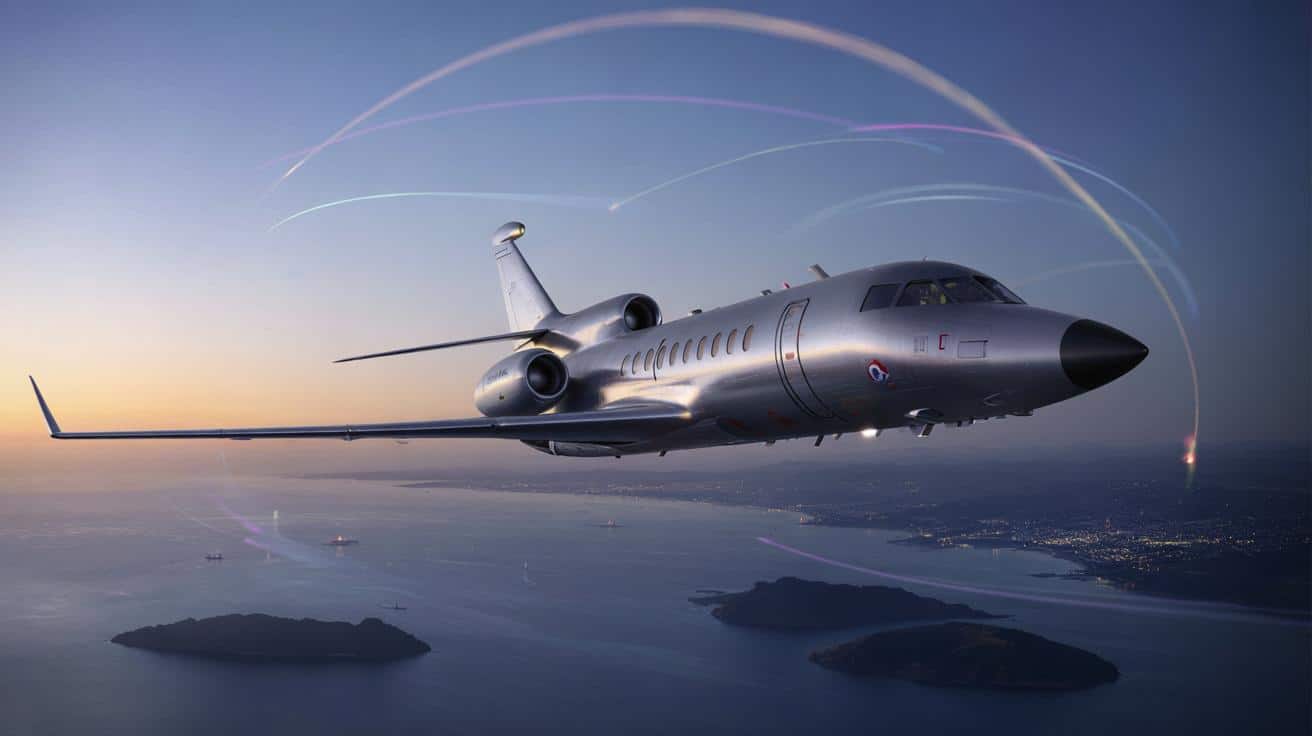
While fighter jets and drones hog the headlines, Paris is investing heavily in something more discreet: long-range electronic-intelligence aircraft that listen, rather than shoot. With its new ARCHANGE programme, France is edging into a tiny club of nations able to field sovereign, high-end SIGINT platforms — and could soon rank fourth worldwide for this type of high‑tech spy plane.
Sigint aircraft: the silent hunters of modern conflict
Modern warfare extends into an invisible battlefield: the electromagnetic spectrum. Every radar beam, radio call, satellite phone or jammer leaves a signal. Capturing those emissions, classifying them and mapping where they come from gives armed forces a detailed picture of what an adversary is doing, often before the first shot.
That role falls to SIGINT aircraft — short for “signals intelligence” — and their sub‑branches: ELINT for radar and electronic emissions, and COMINT for communications. They can look like regular business jets from the outside, but their cabins carry racks of antennas, ultra‑sensitive receivers, mission consoles and operators trained to read the noise of a battlefield as clearly as a map.
These aircraft do not drop bombs; they deliver knowledge — which, in strategic terms, can be far more decisive.
By orbiting outside a conflict zone for hours, they pinpoint radar sites, intercept air-defence communications or detect new jamming systems. That data then feeds into targeting, airspace management, nuclear deterrence planning and counter‑terrorist operations.
Archangel in French skies: turning a business jet into a strategic spy
From Falcon 8X to flying intelligence hub
The backbone of France’s new capability is ARCHANGE, a programme that converts the Dassault Falcon 8X business jet into a long‑range SIGINT platform. The 8X is a tri‑jet usually seen transporting CEOs or heads of state. For the French armed forces, its civilian pedigree is a strength rather than a weakness.
The aircraft brings several key advantages:
- Cruise speed close to 950 km/h, enabling quick repositioning
- Range of about 12,000 km without refuelling, allowing intercontinental missions
- Service ceiling around 15,500 metres, ideal for wide-area listening
- Low acoustic and radar signature for discreet operations
- Cabin length of about 13 metres, leaving space for consoles, racks and several operators
Once modified, the Falcon 8X effectively becomes a strategic nerve centre in the air. It can loiter on the edge of a hot zone, quietly soaking up radio traffic, radar pulses and electronic chatter, then relay processed information to command centres in almost real time.
What the French ARCHANGE actually does
ARCHANGE stands for “Avion de Renseignement à CHArge utile de Nouvelle GEnération” — a next‑generation intelligence aircraft with a specialised payload. The programme is managed by France’s defence procurement agency, the DGA, with Thales providing the core mission systems.
➡️ Belgium’s “betrayal” of France will leave a mark on the future of Europe’s defence
➡️ China is building the world’s largest laser crystal to shoot down satellites from the ground
➡️ Poland overtakes France, Germany, Italy and the UK with a historic tank force beyond imagination
Three aircraft are planned by around 2030. Their missions include:
- Listening to enemy communications and radar networks over long distances
- Geolocating emitters such as surface‑to‑air missile batteries or command posts
- Characterising new signals to update threat libraries and electronic-warfare databases
- Feeding targeting and situational-awareness tools for French and allied forces
Inside the cabin, the luxury seating is gone. Instead, operators sit in front of multi‑screen consoles linked to antennas hidden in fairings and fuselage extensions. Thales mission suites handle real‑time signal processing, data fusion and secure communications with ground stations.
Each sortie can generate a vast harvest of data, from the profile of a new radar to the daily rhythm of a foreign military base.
This is not just useful in wartime. In peacetime, quiet patrols help map foreign air-defence networks or track weapons testing, giving French planners a clearer sense of how rivals might behave in a crisis.
A tiny global club – and France aims for the top tier
Few countries, complex technology
Building a high-end SIGINT aircraft is among the most demanding tasks in defence aviation. It requires expertise across aeronautics, electronic warfare, signal processing, cybersecurity, satellite links and secure software. Unsurprisingly, very few states have managed it.
Current leaders include the United States, with large fleets of RC‑135 and EC‑130 variants, and Israel, which tailors compact Gulfstream-based aircraft to its regional needs. Britain operates RC‑135W Airseeker jets procured in close cooperation with Washington. Australia, Germany, Sweden, Russia and China field various platforms with differing levels of sophistication.
| Country | Main SIGINT aircraft | Capability level (approximate) |
| United States | RC‑135, EC‑130H, EC‑37B and others | Large, modernised fleet, global reach |
| United Kingdom | RC‑135W Airseeker | High‑end, heavily reliant on US partnership |
| Israel | “Nachshon” series (G550 based) | Compact, very advanced regional capability |
| France | ARCHANGE (Falcon 8X, 3 planned) | Fully sovereign, entering service from mid‑2020s |
With ARCHANGE, France positions itself in the leading pack. The country moves into roughly fourth place for strategic airborne SIGINT, alongside or slightly behind Israel and behind the US and UK, but ahead of many NATO partners that still depend on allied data.
Why sovereignty in intelligence matters
For Paris, the question is not just technical prestige. A sovereign SIGINT fleet means France can conduct sensitive listening missions without relying on US assets or clearances. That autonomy resonates with its independent nuclear posture and its desire to retain freedom of action in crises involving Africa, the Middle East or the Indo‑Pacific.
Possessing your own high-end SIGINT aircraft turns a country from a data customer into a data supplier inside alliances.
In alliance politics, intelligence is currency. States that bring unique, high-quality information to the table gain influence over planning and strategy. For France, that strengthens its voice within NATO and the European Union on everything from sanctions design to military deployments.
Costs, risks and the hidden infrastructure behind ARCHANGE
A pricey asset that rarely makes the spotlight
These aircraft do not come cheap. France is spending several hundred million euros on just three jets, with life‑cycle costs driven up by specialised crews, secure ground facilities, software upgrades and maintenance for sensitive electronics.
Unlike a carrier or a new fighter, they offer no photogenic fly‑past and no obvious symbol of power. Yet without them, many modern operations would be effectively blind. Fighter pilots need to know which radars are active. Submarines need targeting data. Special forces need to understand how enemy commanders communicate.
There are also risks. SIGINT aircraft tend to operate near contested areas, which makes them tempting targets for long‑range missiles or aggressive intercepts by fighter jets. Their crews must manage a constant balance between getting close enough to collect useful data and staying outside engagement envelopes.
One aircraft, many supporting systems
ARCHANGE is only one piece of a sprawling French intelligence network. In orbit, satellites such as the CSO series provide exquisite optical imagery, while the CERES constellation listens for electromagnetic emissions from space. Upcoming IRIS satellites should add high‑quality infrared coverage, day and night.
On the ground, long‑range GM400 Alpha radars watch airspace out to several hundred kilometres, and the GRAVES system tracks objects in low Earth orbit, including spy satellites and debris. In the air, MQ‑9 Reaper and Patroller drones offer persistent surveillance and targeted listening focused on smaller areas of interest.
French agencies such as the DGSE (external intelligence), DRM (military intelligence) and DGSI (domestic security) then fuse all these technical streams with human sources, cyber intercepts and open‑source information. ARCHANGE does not replace any of this; it strengthens the overall picture with mobile, responsive, high‑bandwidth collection.
Key concepts behind the jargon
What SIGINT, ELINT and COMINT really mean
For readers less familiar with military acronyms, a few definitions help put ARCHANGE in context:
- SIGINT (Signals Intelligence): any intelligence derived from electronic signals, whether communications or radar.
- ELINT (Electronic Intelligence): focused on non‑communication signals, mainly radars and weapon-system emissions.
- COMINT (Communications Intelligence): focused on voice, text and data communications between humans or machines.
In practice, a mission might pick up a new air‑defence radar frequency (ELINT), match it with encrypted radio chatter between units (COMINT), and then link both to satellite images of a missile battery position. That chain gives commanders a much richer basis for decisions.
Scenarios where ARCHANGE could shape outcomes
Imagine a crisis around a coastal region where an adversary is deploying new anti‑ship missiles. An ARCHANGE aircraft could orbit over international waters, mapping radar search patterns, triangulating mobile launchers and detecting the use of jamming systems. That information would help French and allied navies plot safer routes, adjust flight profiles and plan potential strikes on key nodes.
In counter‑terrorism, a quieter mission might involve monitoring radio and satellite-phone usage across a remote area. Over time, analysts could spot unusual clusters of calls, changes in tempo or links between separate groups, allowing targeted operations instead of broad, risky sweeps.
There is a darker side too: states may use SIGINT aircraft to pressure neighbours, probe reaction times or test air‑defence responses. Misread signals or reckless intercepts can trigger dangerous incidents. Managing those tensions will become more complex as more countries acquire advanced airborne SIGINT and push closer to each other’s borders.