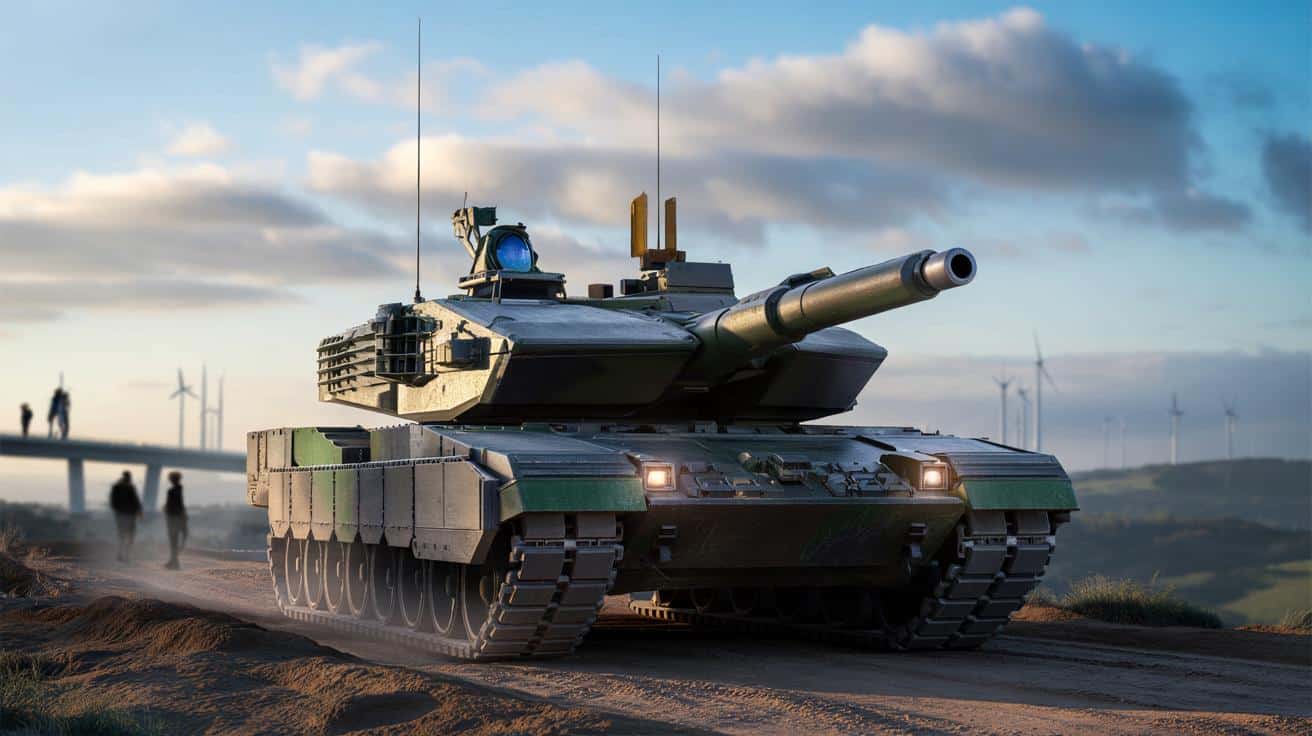
The tank rolled out looked vaguely familiar, yet everything that mattered had changed: where the crew sits, how it fires, how it survives, and how long it can stay relevant. For a combat vehicle that already tops European sales charts, this new upgrade is less a facelift than a statement of intent.
The Leopard that refuses to age
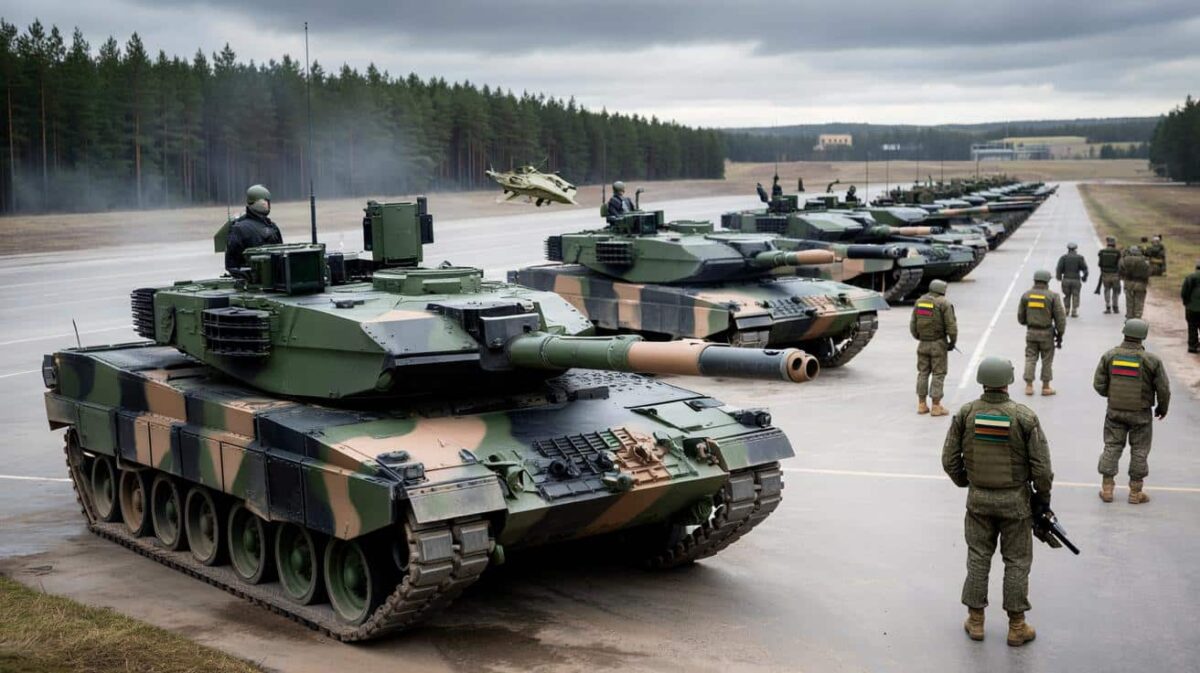
The Leopard 2, built by the Franco-German group KNDS, is already the best-selling main battle tank in Europe, with more than 3,500 units produced in all variants since the 1980s. Many of those vehicles are still serving from the Baltic states to the Gulf.
Rather than designing something completely new from scratch, KNDS is betting on a radical evolution. The latest concept, called Leopard 2A‑RC 3.0, keeps the core strengths of the Leopard family but reshapes how a European tank should fight in the 2030s and 2040s.
The Leopard 2A‑RC 3.0 aims to turn Europe’s most widespread tank into a modular, high-tech platform built to survive decades of upgrades.
Behind the catchy designation lies a clear strategic goal: prevent European armies from drifting towards American M1 Abrams or South Korean K2 Black Panther imports for their next generation of heavy armour.
A tank where no one sits in the turret
The most striking change is invisible from the outside: nobody sits in the turret anymore.
Unlike classic Leopard 2s, where crew members squeeze into a rotating turret under tonnes of steel and ammunition, the new RC 3.0 concept uses a fully automated turret. All three crew members – commander, gunner, driver – are housed in the hull, behind multiple layers of armour and beneath the turret ring.
Automation moves humans to the safest spot
This “crew capsule” approach, inspired partly by Russia’s T‑14 Armata design, aims to reduce casualties from turret hits and ammunition explosions. Sensors, cameras and digital displays give the crew a 360-degree view without exposing themselves.
- The turret is unmanned and remotely controlled
- All firing operations run via digital interfaces
- Cameras and thermal imagers replace periscopes for situational awareness
- Electronics are modular, designed to be swapped as tech advances
For Western Europe, traditionally cautious about crew survivability, this is a cultural shift as much as a technical one.
➡️ China is building the world’s largest laser crystal to shoot down satellites from the ground
➡️ Poland overtakes France, Germany, Italy and the UK with a historic tank force beyond imagination
➡️ Belgium’s “betrayal” of France will leave a mark on the future of Europe’s defence
By moving the crew into a protected armoured capsule, the Leopard 2A‑RC 3.0 accepts that no armour is perfect – so the priority becomes keeping people alive when things go wrong.
Lighter, faster and built for European roads and bridges
Weight is another decisive change. While many Western tanks creep towards or beyond 65 tonnes with add-on armour, the RC 3.0 version is designed to stay under 60 tonnes.
That matters on Europe’s crowded motorways, narrow bridges and rail networks. A lighter tank accelerates faster, needs less fuel, and can actually cross infrastructure rated for lower loads, instead of detouring or risking collapse.
Firepower ready for the next 20 years
At launch, the concept keeps the familiar 120 mm smoothbore gun that made the Leopard family famous. But its architecture is prepared for larger calibres.
KNDS plans for an easy future switch to 130 mm or even 140 mm guns as armour on rival tanks thickens and reactive protection spreads.
The gun is paired with an autoloader able to push up to 18 rounds per minute – a rate no human loader can sustain under combat stress. The turret can also fire Spike LR anti-tank missiles, giving it the option to engage targets beyond 5 km.
With guided missiles and a high-rate autoloader, the Leopard 2A‑RC 3.0 is designed to kill enemy armour before it is even seen through a traditional sight.
Protection that shoots back
Steel and composite armour still matter, but modern tanks no longer rely on mass alone. The Leopard 2A‑RC 3.0 brings in active defence borrowed from Israeli experience.
Active protection and reactive armour
The system selected is Trophy, already combat-tested on Israeli and US vehicles. It detects incoming rockets or missiles, tracks them, and fires interceptors before they hit the tank. On top of that, explosive reactive armour (ERA) blocks line the front and sides, reducing the impact of shaped charges and some kinetic rounds.
The compact, unmanned turret also shrinks the tank’s visual and thermal profile, making it harder to detect on sensors that modern drones and attack helicopters carry.
| Model | Crew in turret | Main gun | Active protection | Approx. weight |
| Leopard 2A‑RC 3.0 (concept) | No | 120 mm, upgradable | Yes (Trophy) | < 60 t |
| T‑14 Armata (Russia) | No | 125 mm | Yes | ~ 55 t |
| Abrams X (USA concept) | No | 120 mm | Yes | ~ 60 t |
| K2 Black Panther (South Korea) | Yes | 120 mm | Optional | ~ 55 t |
Why this matters for Europe’s arms race with the US and South Korea
On the export market, Europe is under pressure. South Korea’s K2 Black Panther has gained momentum, especially with Poland’s large order and local production plans. The United States continues to modernise and market the M1 Abrams, complete with new sensors and improved armour packages.
Against that backdrop, KNDS wants to show that European industry can deliver a future-proof design without relying on American or Asian imports.
The RC 3.0 concept is as much a political signal as a technical leap: Europe intends to keep designing its own high-end armour.
If adopted, the concept could become the backbone of a common European main battle tank programme, replacing ageing Leopards, Leclercs and other legacy vehicles across NATO’s eastern and western flanks.
How it sits in the global tank market
Over the last decade, Russia’s T‑90 family has dominated exports by volume, often to India, Algeria and Egypt. The M1 Abrams has gained new customers in Eastern Europe and the Gulf, while the K2 has used attractive financing and rapid delivery to enter the European market.
The Leopard 2, though produced in smaller numbers recently, has stayed relevant thanks to extensive upgrade projects: new armour kits, digital fire-control systems and improved sights. The RC 3.0 approach extends that logic into a much more ambitious redesign.
What modularity means in practice
“Modular” can sound like marketing jargon, but on a tank it has very concrete effects:
- The gun can be replaced without redesigning the entire turret
- Electronic boxes and sensors can be swapped as new generations arrive
- Armour packages can be tailored to mission: lighter for road mobility, heavier for high-risk fronts
- Future add-ons, like laser warning receivers or drone control consoles, can be integrated into reserved spaces
This approach reduces long-term cost and makes it easier for smaller armies to keep their fleets aligned with technological progress, instead of buying a complete new tank every 20 or 30 years.
What this high-tech shift changes on the battlefield
On a future European battlefield, a Leopard 2A‑RC 3.0 would likely operate in tight coordination with drones, artillery and electronic warfare units. Its unmanned turret lets designers pack in more sensors, from panoramic thermal cameras to future radar-based threat detectors.
Imagine a scenario in eastern Poland or the Baltic region: a tank platoon advances behind a line of small reconnaissance drones. Drones spot enemy vehicles beyond the horizon, send coordinates back, and the tanks engage with long-range missiles or gun-launched rounds without ever exposing themselves to direct line of sight.
Instead of trading shots at 2 km, the new doctrine pushes for first-round kills from several kilometres away, guided by shared battlefield data.
That shift also changes training. Crews must become comfortable managing sensors and data as much as driving and gunnery. The tank becomes a mobile node in a digital network, not just a gun on tracks.
Key terms and trade-offs worth understanding
For readers less familiar with armoured jargon, two concepts drive much of this redesign: active protection and crew survivability.
Active protection systems like Trophy are essentially small, fast-reacting anti-missile defences mounted directly on the tank. They work best in complex environments, such as towns, where attacks can come from multiple angles at short notice. They are not a magic shield: large-calibre kinetic rounds, artillery or top-attack munitions can still be deadly.
The crew capsule philosophy accepts that no tank can be invulnerable against all threats. Instead, designers focus on containing damage: preventing ammunition from detonating into the crew space, improving fire suppression, and supporting rapid evacuation if the hull is breached.
That brings trade-offs. An unmanned turret complicates maintenance, since some repairs now require external access or specialised tools. The reliance on electronics increases vulnerability to battlefield wear, shock and, in the future, cyber interference. Armies adopting such systems will need robust logistics and technical training, not just skilled drivers and gunners.
For European forces operating under tight budgets and political scrutiny, these are not just engineering questions. They shape whether governments can justify investing in a “European tank” rather than buying ready-made models from the US or South Korea at short notice.