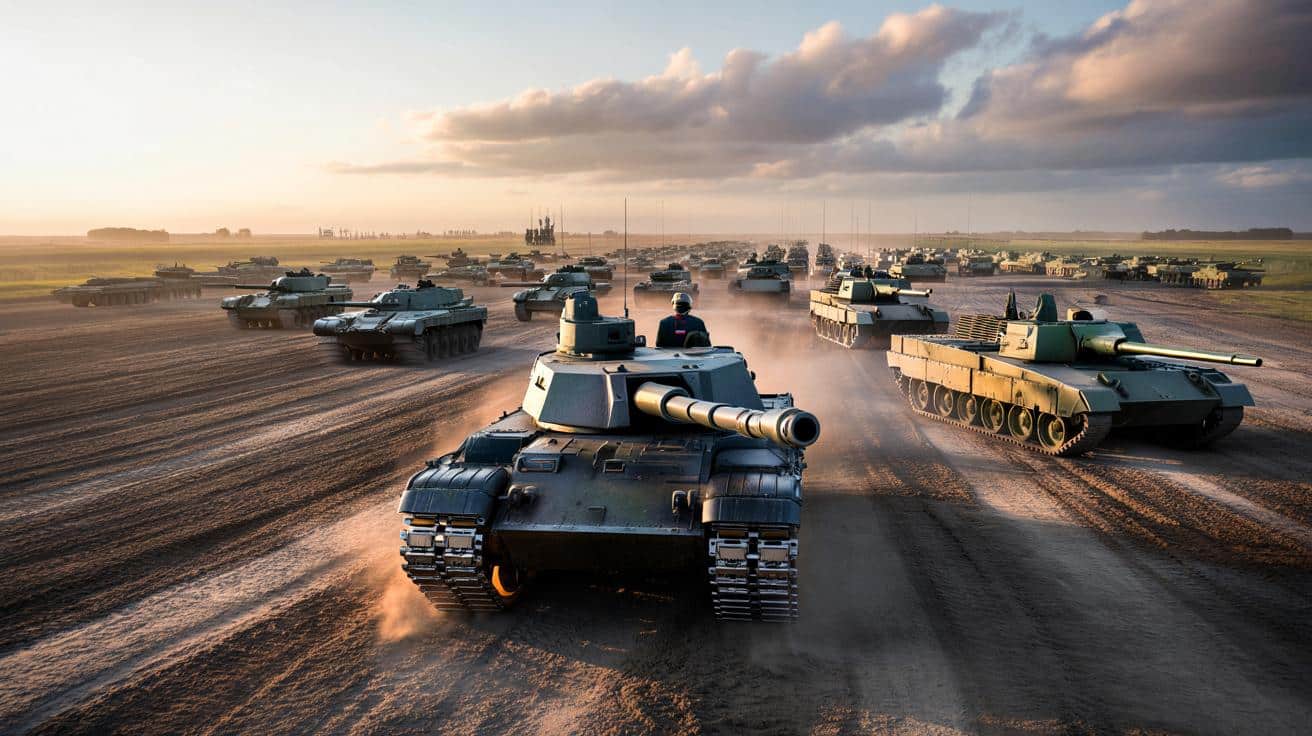
Poland has launched an unprecedented armoured build-up, signing multibillion-euro deals that will give it more tanks than France, Germany, Italy and the UK combined by 2030. The move is transforming Warsaw from a “frontline state” into a heavyweight land power inside the Alliance.
Poland’s grand tank gamble
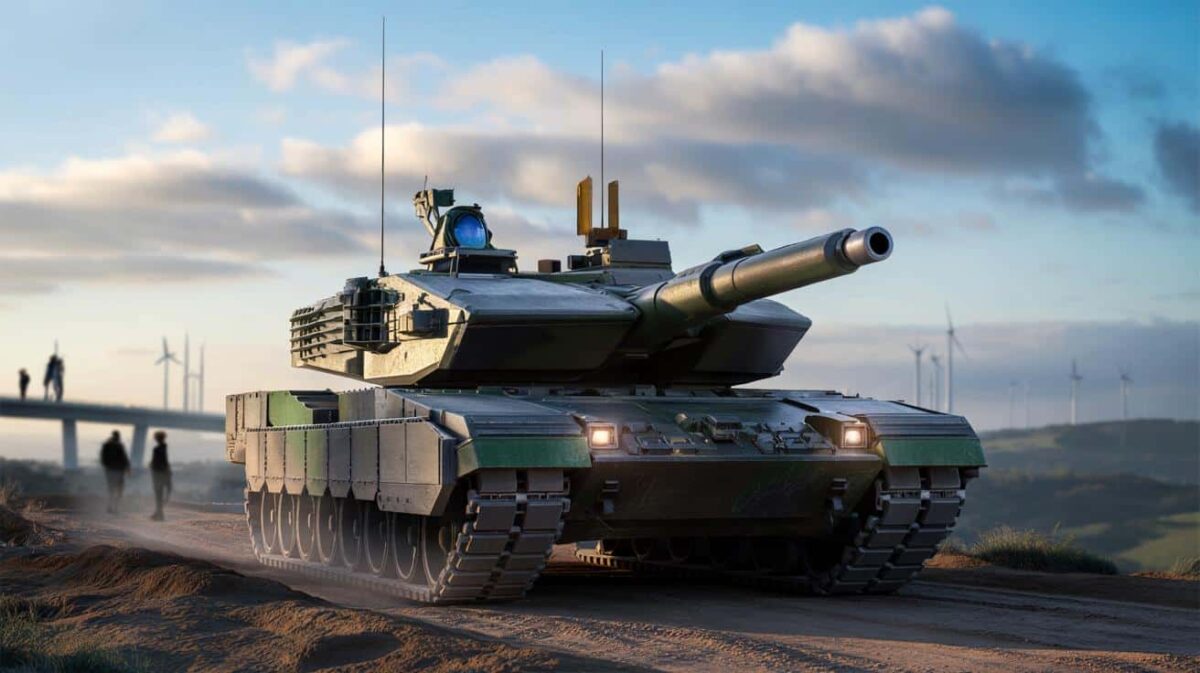
At the heart of this shift lies a colossal contract with South Korea for K2 Black Panther main battle tanks. Warsaw has committed around €6.1 billion for 180 additional K2s, on top of the vehicles already ordered, with a crucial twist: dozens will be produced on Polish soil.
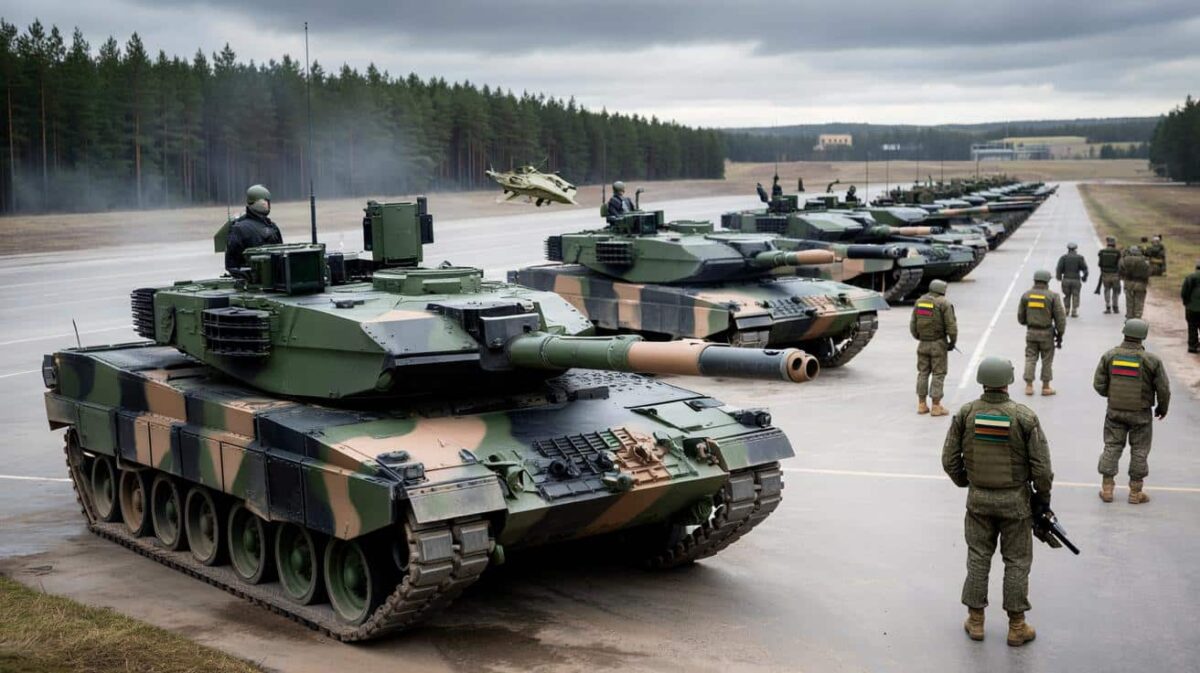
Poland is on track to field more than 1,100 tanks by 2030, outnumbering the combined fleets of France, Germany, Italy and the UK.
The political message is as strong as the military one. Poland does not just want to buy tanks; it wants to build and sustain them at home. The agreement includes technology transfers, local assembly in Gliwice and the creation of new industrial capacity in the Polish defence sector.
For Warsaw, that means jobs, know‑how and a degree of independence in maintenance and upgrades. For its neighbours, it signals that Poland intends to be more than a customer in the European defence market. It wants to be a producer and a long‑term player.
An armoured fleet that dwarfs western Europe
If current plans hold, Poland’s tank park will look striking by the end of the decade. The figures already stand out in a region known for cautious defence spending.
| Model | Supplier | Planned number by 2030 |
| K2 Black Panther | South Korea | 360 |
| M1 Abrams | United States | 366 |
| Leopard 2 | Germany | 235 |
| PT‑91 (modernised) | Poland (Soviet legacy upgraded) | ≈150 |
| Total estimated tanks | — | 1,100+ |
By comparison, the combined number of operational main battle tanks in service with France, Germany, Italy and the UK is expected to remain under 950 for the same timeframe. Those countries are focusing on smaller, more expensive fleets and long-term projects such as the Franco‑German MGCS (Main Ground Combat System), planned for around 2040.
While Paris and Berlin project a future super‑tank, Warsaw is buying hardware that will be ready this decade.
A tight delivery schedule
Poland’s calendar is compressed and direct. The K2 programme alone is broken down into clear steps:
➡️ China is building the world’s largest laser crystal to shoot down satellites from the ground
➡️ France on track to become the world’s 4th biggest power in ultra-secret SIGINT spy aircraft
➡️ Belgium’s “betrayal” of France will leave a mark on the future of Europe’s defence
- First batches already arrived between 2022 and 2023, with 82 K2s in service.
- A second wave of 119 K2s is scheduled between 2025 and 2027.
- From 2028 to 2030, at least 61 tanks should roll off assembly lines in Poland.
This pace contrasts with the more measured, often delayed procurement cycles seen in western Europe. For Polish leaders, speed is not a luxury but a response to what they see as an immediate security risk triggered by Russia’s full‑scale invasion of Ukraine.
Defence as a national priority
Warsaw has pushed defence spending to levels rarely seen in peacetime. The government is devoting around 4.7% of its GDP to the military, roughly double NATO’s 2% guideline and far above most European allies. That translates into an estimated €30 billion a year.
Behind that number lies a deep historical trauma. Poland was invaded and partitioned multiple times in the 20th century, including by both Nazi Germany and the Soviet Union. Political leaders now frame massive rearmament as a kind of strategic insurance policy so that the country is never again caught off guard.
For many Poles, a powerful army is seen less as a symbol of aggression than as a collective life insurance.
More than tanks: a complete modern force
The tank programme grabs headlines, but it sits within a much broader shopping list aimed at turning Poland into a fully modern, combined‑arms military power. Recent acquisitions and orders include:
- K239 Chunmoo multiple rocket launchers from South Korea.
- K9 Thunder self‑propelled howitzers, also South Korean.
- FA‑50 light combat aircraft for training and air policing.
- AH‑64 Apache attack helicopters from the US.
- Patriot air and missile defence systems, again from the US.
This mix of suppliers reduces dependence on any single partner and gives Warsaw leverage in future negotiations. It also reflects a bet on South Korean defence firms, which have built a reputation for fast delivery and competitive pricing, and on the enduring security relationship with Washington.
The industrial angle: tanks as an export ticket
Reintroducing tank production inside Poland serves a strategic economic goal. Local assembly of K2s is expected to involve Polish subcontractors, engineers and technicians, reviving skills that had faded since the Cold War.
Looking ahead, Warsaw hopes to become a hub for maintenance and upgrades of K2s and other systems across central and eastern Europe. If that happens, Polish factories could end up servicing not only domestic units but also allied fleets, turning the country into a net exporter of defence services and, potentially, of finished vehicles.
By building tanks at home, Poland is positioning itself as both Europe’s armoured shield and a future supplier to its neighbours.
A shock to Europe’s strategic balance
Poland’s rearmament is forcing a rethink in western capitals. For decades, military leadership in Europe was associated with France, the UK and Germany, thanks to their nuclear arsenals, expeditionary forces and defence industries. A heavily armed Poland complicates that picture.
On land, Warsaw could soon field the most powerful heavy army in the European Union. That gives it more weight in debates over NATO strategy, defence spending and deterrence against Russia. It also raises questions about interoperability, logistics and command structures in wartime.
Some analysts welcome Poland’s push as a relief for a stretched US military that has long carried much of NATO’s deterrence burden in Europe. Others worry about fragmentation, with different countries buying different platforms rather than coordinating on joint programmes.
A direct message to Moscow
Polish officials rarely conceal the target of their planning. The new armour is meant to deter Russia from testing NATO’s eastern flank and, if necessary, to fight in high‑intensity ground combat.
In a conflict scenario, Polish heavy brigades equipped with K2s, Abrams and Leopards could form a dense armoured barrier between Russia and the rest of the Alliance. The presence of US‑made systems like Abrams and Patriot also acts as a political signal: any attack on Polish territory would almost automatically drag Washington into the fight.
An armoured force of more than a thousand modern tanks is designed less for symbolic shows of force than for concrete battlefield credibility.
Key concepts and risks behind the tank build‑up
The term “main battle tank” (MBT) refers to heavily armoured tracked vehicles that combine high firepower, protection and mobility. MBTs like the K2 or Abrams are intended to punch through enemy lines, support infantry and hold ground under intense fire. They are expensive to buy and extremely costly to operate, requiring large logistics tails and specialised crews.
Poland’s choice to field several different MBT types brings trade‑offs. On the one hand, it increases redundancy: if a supply chain is disrupted for one model, the others can still operate. On the other, it complicates training, spare parts, maintenance and ammunition management. Keeping Abrams, K2s, Leopards and upgraded PT‑91s ready at once will test Poland’s logistics system.
There are also political and economic risks. Future governments could face pressure to scale back defence budgets if growth slows or social demands rise. A change of leadership in Washington or Seoul could alter the tone of arms cooperation. Public opinion, currently supportive, might shift if costs balloon or if scandals emerge around procurement processes.
Scenarios for the next decade
Several realistic scenarios are being discussed in defence circles:
- Strengthened eastern shield: Poland completes most of its tank plans, becomes the backbone of NATO’s ground forces in the region and hosts regular large‑scale exercises integrating US, British and Baltic units.
- Partial slowdown: Economic pressures delay some deliveries, pushing parts of the programme into the 2030s, but still leaving Poland with one of Europe’s largest tank fleets.
- Export pivot: After equipping its own units, Poland and South Korea jointly market modified K2 variants to other European states, turning Polish plants into a key supply base.
Whatever path unfolds, one fact is already clear: in the space of a few years, Poland has moved from being a relatively modest land power to planning a historic armoured force that reshapes how Europe thinks about tanks, deterrence and the balance of military influence inside NATO.